
Feb 07, 2026
Feb 17, 2026

Understand When Lenders Ask for a Loan Guarantor and How It Impacts Approval.
Authored by FlexiLoans | Date: 07/02/2026
- Quick Summary
- What: A loan guarantor is a third party who agrees to repay a business loan if the borrower defaults. Some business loans require a guarantor depending on risk, credit profile, and business stability.
- Why: Lenders ask for guarantors to reduce repayment risk, especially when the borrower has limited credit history, inconsistent cash flow, or a newly established business.
- Who: Small business owners, self-employed professionals, startups, partnership firms, and MSMEs applying for unsecured business loans.
- How: Guarantor requirements depend on credit score, business vintage, loan amount, and lender policy. Digital NBFCs like FlexiLoans may approve loans without guarantors for eligible profiles.
- Use Case: A growing MSME with a moderate credit score secures funding faster by adding a financially strong guarantor, improving lender confidence.
When applying for a business loan, many entrepreneurs are surprised by one question:
“Do you have a guarantor?”
While not all business loans require one, guarantor requirements are still common, especially for unsecured loans or borrowers with higher risk profiles. Understanding when a guarantor is needed, who can serve as a guarantor, and how it affects approval can help business owners better prepare and avoid delays or rejections.
This guide explains business loan guarantor requirements in 2026, how lenders evaluate risk, and when you can get funding without involving a guarantor, particularly through digital lenders like FlexiLoans.
What Is a Loan Guarantor in Business Loans?
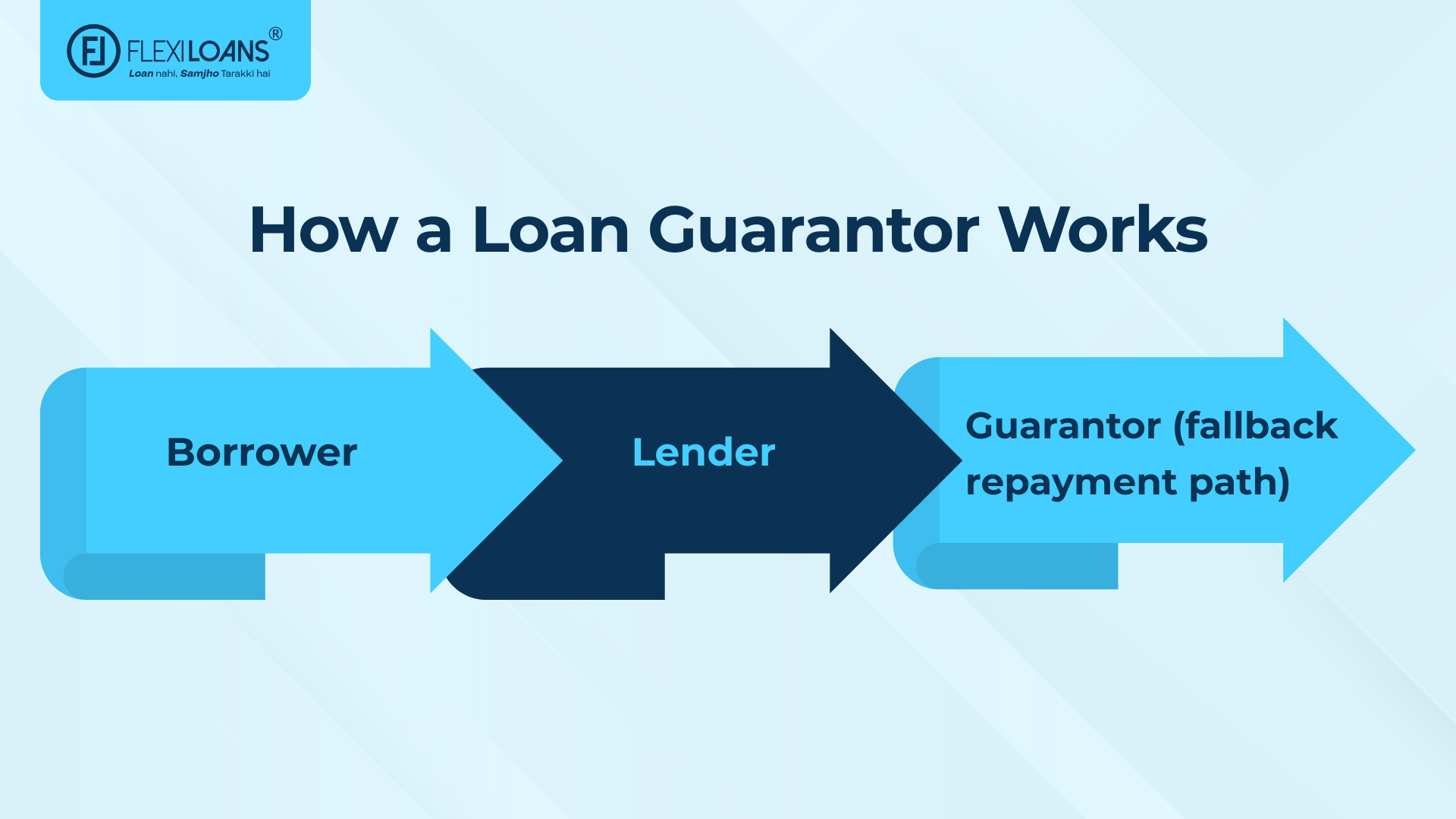
A loan guarantor is an individual who legally agrees to repay a business loan if the borrower fails to meet repayment obligations. The guarantor provides additional assurance to the lender but does not receive the loan funds.
In business lending, guarantors are commonly requested for:
- Unsecured business loans.
- New or small businesses with a limited track record.
- Borrowers with moderate or low credit scores.
Why Do Lenders Ask for a Guarantor?
From a lender’s perspective, business loans, especially unsecured ones, carry higher risk. A guarantor reduces this risk by adding an additional layer of repayment security.
Lenders typically request a guarantor to:
- Improve loan recoveries in the event of default.
- Compensate for weak credit scores or thin credit history.
- Support higher loan amounts without collateral.
- Strengthen confidence in early-stage businesses.
For borrowers, having a guarantor can increase approval chances or lead to better loan terms.
When Is a Guarantor Required for a Business Loan?
A guarantor is not mandatory for every business loan. It is usually required under specific conditions:
- Low or borderline CIBIL score: Scores below lender thresholds may trigger guarantor requirements.
- Short business vintage: Businesses operating for less than 1–2 years.
- High loan amount: Larger ticket sizes increase lender risk.
- Inconsistent cash flow: Irregular bank inflows raise concerns about repayment.
- Certain business structures, such as partnerships or proprietorships, may require personal guarantees.
Each lender applies these factors differently based on internal risk models.
Who Can Act as a Business Loan Guarantor?
A guarantor must meet basic financial and legal eligibility criteria. Typically, lenders look for:
- Strong credit score (usually 700+).
- Stable income or business earnings.
- Clean repayment history.
- Close relationship with the borrower (family member, business partner, or promoter).
Guarantors must understand that their credit scores and financial standing will be directly affected if the borrower defaults.
What Are the Risks and Responsibilities of a Guarantor?
Becoming a guarantor is a serious financial commitment. If the borrower fails to repay:
- The lender can demand repayment from the guarantor.
- The guarantor’s credit score may be affected.
- Legal recovery action can be initiated if dues remain unpaid.
For this reason, guarantors should review loan terms carefully and assess repayment capacity before agreeing.
Can You Get a Business Loan Without a Guarantor?
Yes. Many digital lenders and NBFCs now offer business loans without guarantors, especially for financially disciplined borrowers.
You are more likely to qualify without a guarantor if you have:
- Strong bank statement inflows.
- Stable business operations.
- Acceptable credit score.
- Reasonable loan amount relative to income.
How FlexiLoans Evaluates Guarantor Requirements
FlexiLoans uses a data-driven credit assessment model that evaluates:
- Bank statement cash flow.
- Business stability and turnover.
- Credit behaviour and repayment patterns.
In many cases, eligible borrowers can secure collateral-free, guarantor-free business loans, depending on their financial profile, making the process faster and less dependent on third parties.
Smart Ways to Reduce the Need for a Guarantor
To improve your chances of getting a loan without a guarantor:
- Maintain consistent bank inflows.
- Avoid EMI defaults and cheque bounces.
- Limit over-borrowing.
- Apply for loan amounts aligned with cash flow.
- Keep business and personal finances clearly documented.
These steps help lenders rely solely on your financial strength.
Conclusion
Guarantor requirements in business loans depend on risk, not rules. While some borrowers may need a guarantor to strengthen their application, many businesses today can access funding without involving third parties, especially through digital lenders.
With FlexiLoans, eligible MSMEs and self-employed professionals can secure fast, collateral-free business loans, often without a guarantor, based on real financial performance. Understanding when a guarantor is needed helps you plan better and choose the right funding path.
FAQs: Business Loan Guarantor Requirements
Ans: Lenders typically require a guarantor when the borrower’s risk profile is higher. This can include a low or borderline CIBIL score, limited business vintage, inconsistent bank cash flows, or a higher loan amount relative to income. A guarantor strengthens the lender’s confidence by providing an additional fallback for repayment.
Ans: No, a guarantor is not mandatory for all unsecured business loans. Many digital lenders, including FlexiLoans, assess applications using cash flow, bank statement behaviour, and credit history. If the borrower meets internal risk criteria, loans can be approved without a guarantor.
Ans: A guarantor must be financially stable, have a strong credit score (usually 700+), and a clean repayment history. Common guarantors include family members, business partners, or promoters who can demonstrate reliable income and creditworthiness.
Ans: Once a guarantor signs the agreement, they are legally obligated to repay the loan if the borrower defaults. This responsibility continues until the loan is fully repaid, and any default can negatively impact the guarantor’s credit score and financial standing.
Ans: Yes. Adding a financially strong guarantor can significantly improve approval chances, help secure higher loan amounts, or result in better loan terms, especially for businesses with limited credit history or early-stage operations.
Ans: In most cases, a guarantor cannot be removed during the loan tenure unless the lender agrees after reassessing the borrower’s financial strength. Such changes are rare and require formal approval and documentation.
Ans: No. FlexiLoans follows a data-driven lending approach. Depending on cash flow stability, business performance, and credit behaviour, many borrowers can access business loans without a guarantor.
Glossary: Key Terms Explained
| Term | Definition |
| Loan Guarantor | An individual who legally commits to repaying a loan if the primary borrower fails to meet repayment obligations. |
| Business Loan | A financing facility provided to businesses for expansion, working capital, asset purchase, or operational needs. |
| Unsecured Loan | A loan approved without collateral, based primarily on income, credit profile, and repayment capacity. |
| Credit Score | A numerical indicator (300–900) that reflects a borrower’s credit behaviour and repayment reliability. |
| CIBIL | India’s leading credit bureau that maintains credit records and generates credit scores for individuals and businesses. |
| Cash Flow | The net inflow and outflow of money in a business account are used to assess repayment ability. |
| Business Vintage | The length of time a business has been operational indicates stability and continuity. |
| EMI (Equated Monthly Installment) | A fixed monthly payment comprising principal and interest is used to repay a loan over time. |
| Default | Failure to repay loan EMIs or dues as per the agreed repayment schedule. |
| NBFC | A Non-Banking Financial Company authorised to provide loans and financial services without being a bank. |
| Risk Assessment | The lender’s evaluation of a borrower’s financial strength, credit behaviour, and repayment likelihood. |
| Repayment Capacity | The borrower’s ability to service loan EMIs is based on income, expenses, and cash flow stability. |
| Co-Applicant | A joint borrower who shares legal responsibility for loan repayment along with the primary applicant. |
| Loan Tenure | The total period over which the borrower agrees to repay the loan. |
| Disbursal | The process of transferring the approved loan amount to the borrower’s bank account. |

Is this information helpful?
 Disclaimer

Nishit Bhandari
Nishit Bhandari is a finance professional and content strategist at FlexiLoans. He focuses on MSME, business, and term loan solutions. With over 5 years of expertise in digital lending and credit access, he creates content that helps entrepreneurs make informed financial decisions. His work is driven by a passion to simplify complex finance concepts and empower small businesses to grow with confidence. Nishit holds an MBA in Finance from NMIMS, Mumbai, and is a Certified Credit Professional from IIBF.
Recent Posts
-

Business Loan Refinancing: Lower Your EMI & Interest Rate in 2026
Mar 05, 2026 -
Business Loan Maximum Amount: How Much Can MSMEs Borrow in 2026?
Mar 04, 2026 -

7 Government Schemes to Empower Women in India
Mar 03, 2026 -

Success Stories: How FlexiLoans Helped MSMEs Unlock Their Growth Potential
Feb 24, 2026 -

10 Smart Ways to Use MSME/SME Loans to Expand Your Business
Feb 23, 2026