
Feb 04, 2026
Feb 05, 2026
How MSMEs Can Access Funding for Clean Energy Transition Post-Budget 2026
Authored by FlexiLoans | Date: 04/02/2026
- Quick Summary
- What: Green business loans support MSMEs in financing solar installations, electric vehicle (EV) adoption, and related upgrades. Budget 2026 enhances certain incentives for renewable energy and clean technology infrastructure.
- Why: Solar and EV upgrades improve operational efficiency and reduce long-term energy costs, but upfront costs can be high. Green financing and targeted incentives help businesses bridge that gap.
- Who: Retailers, manufacturers, logistics operators, service providers, and other MSMEs looking to adopt solar power or EVs for their business operations.
- How: By blending government incentives, clean energy subsidy schemes, and commercial green business loans (including options from digital lenders), businesses can fund green assets while managing cash flow.
- Use Case: A retail store installs rooftop solar panels using a green business loan that spreads the cost over time, and accesses available tax relief and lower capital costs due to customs duty rationalisation on solar equipment.
As India intensifies its focus on renewable energy and cleaner transportation, MSMEs are exploring solar energy systems and electric vehicle (EV) transitions as means to cut energy costs, enhance sustainability, and gain a competitive advantage. However, the upfront investment required for these green upgrades often exceeds the immediate financial capacity of small businesses.
Budget 2026 continues to support clean energy adoption through policy measures such as customs duty exemptions on solar inputs and battery manufacturing equipment, which reduce hardware costs for solar and EV infrastructure.
For many MSMEs, however, green business loans, including solar financing and EV capex loans, remain essential to bridge the funding gap.
What Are Green Business Loans?
A green business loan is a type of commercial financing used to fund environmentally sustainable assets and operations. For MSMEs, common applications include:
- Rooftop solar panel installation and net metering setups.
- EV fleet purchases and charging infrastructure.
- Energy storage systems, including batteries.
- Other clean technology upgrades that reduce carbon footprint.
These loans may be standard business loans labelled “green” based on the purpose of use or may be structured with flexible tenor or working capital components suitable for asset deployment.
Budget 2026 Green Energy Context
While Budget 2026 did not announce dedicated new MSME solar subsidies, it significantly addressed green industry conditions with:
- Customs duty exemptions on solar glass and inputs, lithium-ion battery cell machinery, and related equipment that lower input costs for solar and EV systems.
- Large capital allocations to clean energy sectors and grid infrastructure, signalling broader industry support.
These measures reduce the effective capex for green assets, making financing needs more manageable.
Solar Financing: How It Works for Businesses
Solar financing typically works through:
- Loan or lease funding: MSMEs take out a solar loan to cover the cost of purchasing and installing PV panels, inverters, and related systems.
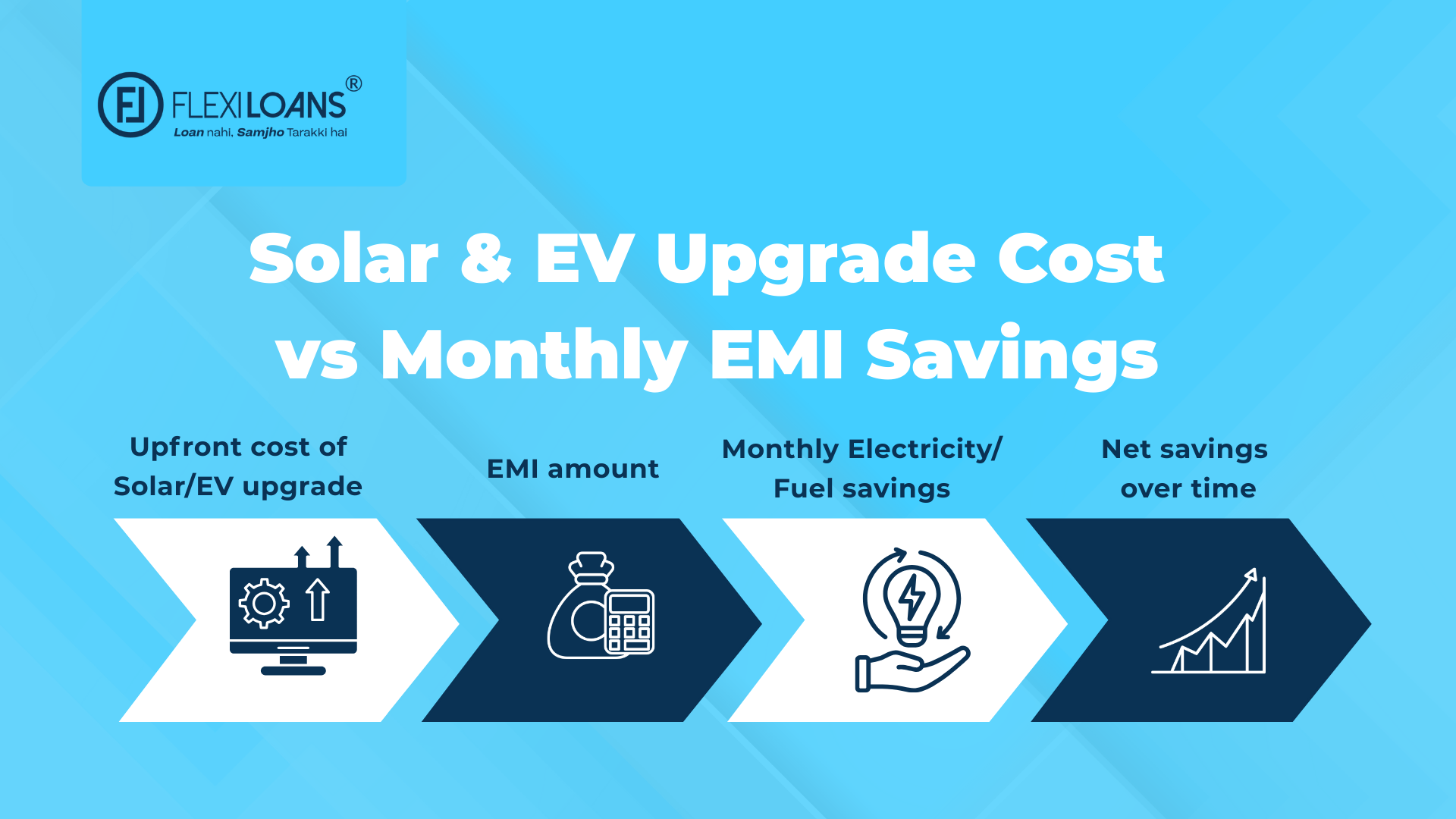
- Cash flow alignment: The expected energy savings help cover loan EMIs over time.
- Installation partner financing: Some solar vendors partner with lenders to offer integrated financing.
Costs are reduced by lower import duties on solar inputs, which indirectly support better pricing for installations and hardware.
EV Financing for MSMEs
Electric vehicles and associated infrastructure (such as charging stations) can be expensive. EV financing options include:
- Commercial vehicle loans adapted for electric 2-wheelers, 3-wheelers, and light electric commercial vehicles.
- Term loans for EV acquisition.
- Asset financing with longer tenors to match operational cash flows.
While Budget 2026 emphasises solar and storage input duty relief, continued cost reductions in battery systems and EV ecosystem equipment can be financed more affordably due to lower capex barriers.
Government Incentives and Subsidies
Although there are no newly announced direct MSME solar or EV subsidies in Budget 2026, the policy environment includes enduring and related supports:
- Import duty exemptions for solar glass and lithium-ion battery machinery reduce asset costs.
- Subsidy programmes at the state level (e.g., solar pump subsidies) and rooftop solar schemes continue to support deployment, though not newly specified in the 2026 Budget.
Businesses should verify eligibility for such schemes when planning upgrades, as these savings augment financing strategies.
Comparing Green Loans vs Conventional Business Loans
| Aspect | Green Business Loan | Conventional Business Loan |
| Purpose | Solar, EV, storage, clean assets | General working capital and business needs |
| Interest rates | Based on the credit profile, not inherently lower, but strategic use reduces the total cost | Standard market rates depending on risk |
| Asset linkage | Tied to green assets | Flexible usage |
| Impact | Reduces energy cost long-term | Supports liquidity and operations |
| Government context | Supported by duty relief and green industry push | Supported by general MSME credit enhancements |
A green business loan is a targeted tool, ideal for funding specific clean energy assets. Conventional business loans offer broader flexibility.
When to Consider a Green Business Loan
Businesses should choose green financing when:
- They have a clear capital plan for solar or EV upgrades.
- Projected energy cost savings support loan repayment over time.
- Import duty reductions lower upfront hardware capex.
- They aim to improve sustainability and reduce operational expenses.
For many MSMEs, blending asset financing with broader working capital solutions provides the best overall cash flow management strategy.
Lending Platforms such as FlexiLoans offer business loans that can be used for green asset installation, helping eligible MSMEs fund solar projects or EV transitions without collateral.
Budget 2026 reaffirmed India’s long-term commitment to clean energy by easing costs for solar and battery systems through duty exemptions. For MSMEs, the practical pathway to adoption still lies in well-structured financing that aligns payment schedules with operational cash flows and energy savings.
Conclusion
Adopting solar and EV technologies can significantly reduce MSMEs’ long-term energy costs and support sustainability goals. While Budget 2026 did not introduce specific MSME green subsidies, policy support through import duty relief and broader clean energy allocations helps lower asset costs.
Green business loans provide a practical financing route for solar and EV upgrades. When combined with existing incentives and strategic financing, these loans help MSMEs transition sustainably while preserving working capital.
FAQs
Ans: A green business loan is financing for environmentally sustainable assets such as solar power systems, electric vehicles, and energy storage solutions.
Ans: Budget 2026 did not announce specific green subsidies for MSMEs, but it reduced import duties on solar and battery equipment, indirectly lowering the cost of green technologies.
Ans: Solar loans help businesses pay for renewable energy systems over time, with payments aligned to energy cost savings from lower electricity bills.
Ans: Yes. Many lenders offer commercial loans that can finance electric vehicles and related charging infrastructure, provided the business meets eligibility criteria.
Ans: Interest rates depend on the borrower’s risk profile and market conditions. Green loans may not inherently cost less, but can be cost-effective when paired with duty relief and operational savings.
Glossary: key terms explained
| Term | Definition |
| Green Business Loan | A loan provided to fund environmentally sustainable equipment or projects such as solar panels, batteries, or electric vehicles. |
| Solar Financing | Funding specifically used to purchase, install, or upgrade solar energy systems for a business. |
| Electric Vehicle (EV) Financing | Loans or credit arrangements used to acquire electric vehicles or charging infrastructure. |
| Import Duty Exemption | Government relief that removes customs taxes on certain imported goods, reducing the cost of assets. |
| Clean Energy Asset | Equipment or infrastructure that supports renewable energy or energy efficiency, such as solar panels and storage systems. |
| Working Capital Loan | A loan used to finance day-to-day business needs, such as inventory or payroll. |
| Rooftop Solar | Solar photovoltaic systems installed on building rooftops to generate electricity for self-use. |
| Energy Storage Systems | Batteries or similar technologies are used to store electricity for later use. |
| Net Metering | A billing arrangement in which excess solar power is exported to the grid earns credit for electricity consumed. |
| Import Duty | Customs tax collected on goods brought into a country. |
| Credit Assessment | Evaluation of a borrower’s financial profile to determine loan eligibility. |
| Collateral-Free Loan | A loan that does not require the borrower to pledge assets as security. |
| Operational Savings | Money saved in daily expenses, such as energy costs, due to asset upgrades. |
| Sustainable Investment | Funding used for projects or assets that have environmental benefits. |
| Capex (Capital Expenditure) | Funds used to purchase or upgrade physical assets such as equipment. |

Is this information helpful?
 Disclaimer

Nishit Bhandari
Nishit Bhandari is a finance professional and content strategist at FlexiLoans. He focuses on MSME, business, and term loan solutions. With over 5 years of expertise in digital lending and credit access, he creates content that helps entrepreneurs make informed financial decisions. His work is driven by a passion to simplify complex finance concepts and empower small businesses to grow with confidence. Nishit holds an MBA in Finance from NMIMS, Mumbai, and is a Certified Credit Professional from IIBF.
Recent Posts
-

Success Stories: How FlexiLoans Helped MSMEs Unlock Their Growth Potential
Feb 24, 2026 -
10 Smart Ways to Use MSME/SME Loans to Expand Your Business
Feb 23, 2026 -
Top 10 Financial Mistakes MSMEs Should Avoid and How to Overcome Them (2026 Guide)
Feb 21, 2026 -
Explore The Best Working Capital Finance Options For Your MSME (2026 Guide)
Feb 20, 2026 -

How to Raise Funds to Grow Your Business in India (2026 Guide)
Feb 19, 2026