
Feb 12, 2026
Feb 17, 2026
Flexible Financing Solutions for Home Entrepreneurs and Small Business Owners
Authored by FlexiLoans | Date: 12/02/2026
- Quick Summary
- What: A home business loan is a collateral-free business loan designed for entrepreneurs operating from home, including online sellers, consultants, freelancers, and service providers.
- Why: Home-based businesses require funding for working capital, technology upgrades, inventory, marketing, and scaling operations, without the burden of pledging assets.
- Who: Self-employed individuals, sole proprietors, freelancers, and small business owners running operations from home.
- How: Eligibility is assessed using income stability, bank statements, business vintage, and credit profile. Digital lenders like FlexiLoans offer fast, paper-light approvals.
- Use Case: A home-based e-commerce seller secures quick funding to purchase inventory and run digital marketing campaigns during peak sales season.
The rise of work-from-home entrepreneurship has transformed how businesses operate in India. From online stores and consultants to digital service providers and home-based manufacturers, thousands of entrepreneurs now run profitable ventures without traditional office setups.
However, access to timely finance remains a common challenge. Traditional lenders often hesitate to fund home-based businesses because they lack commercial premises or collateral. This is where home business loans from digital NBFCs like FlexiLoans bridge the gap, offering fast, unsecured funding tailored to modern business models.
This guide explains how home-based businesses can secure a business loan in 2026, covering eligibility, interest rates, application steps, and approval strategies.
What Are Business Loans for Home-Based Businesses?
A business loan for a home-based business is an unsecured loan offered to entrepreneurs who operate their business from a residential location. These loans are structured to support businesses that may not have formal office spaces but demonstrate consistent income and operational stability.
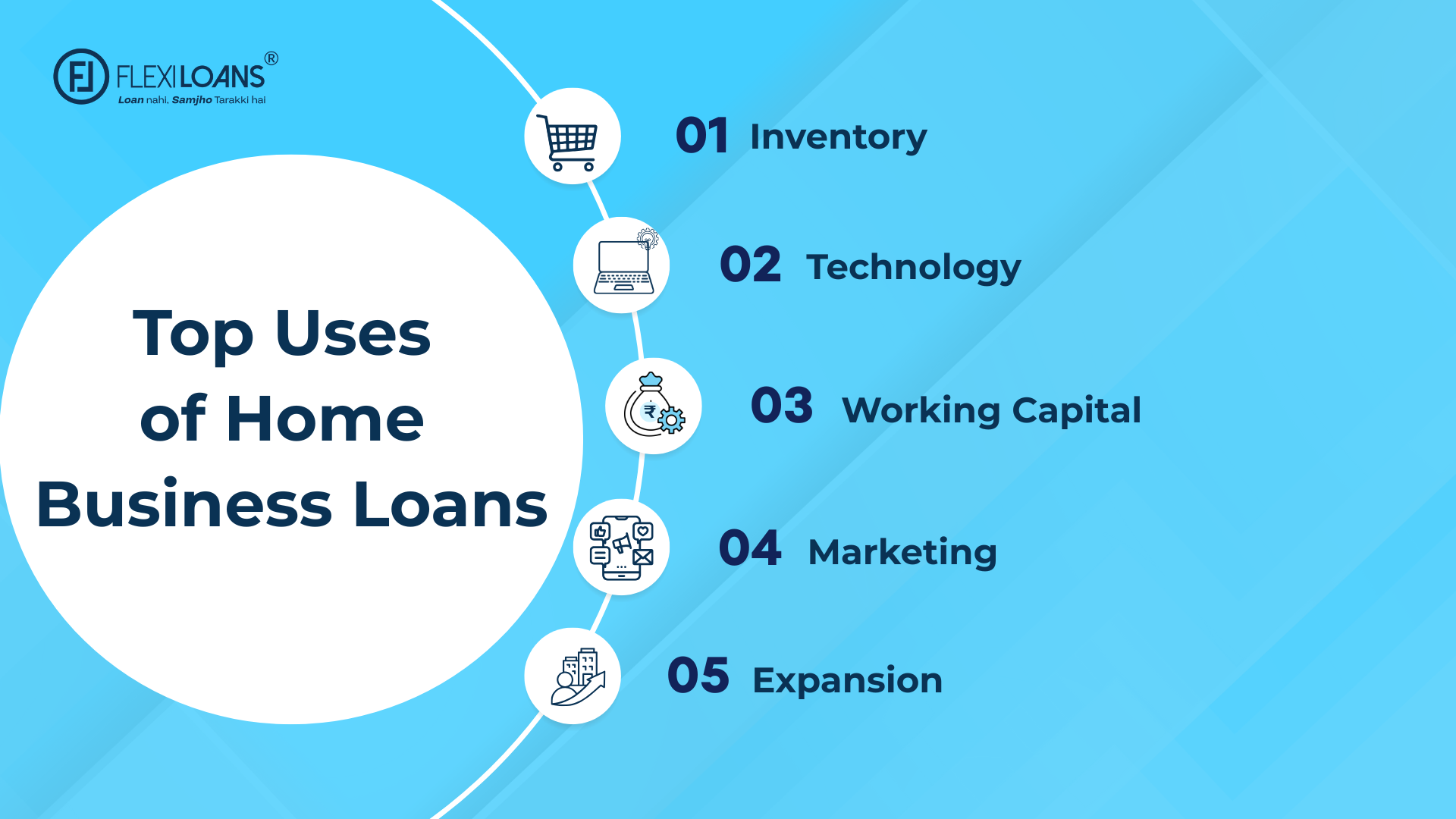
Loan funds can be used for multiple business needs, including:
- Purchasing inventory or raw materials.
- Investing in laptops, software, or equipment.
- Running digital marketing and customer acquisition campaigns.
- Managing working capital and recurring expenses.
- Scaling operations or hiring remote staff.
Why Do Home-Based Businesses Need Business Loans?
Home-based entrepreneurs often operate with limited financial buffers. A business loan helps them move from survival mode to sustainable growth by addressing key challenges.
Access to funding allows home businesses to:
- Scale faster without disrupting cash flow.
- Invest in tools and systems that improve productivity.
- Compete with larger, office-based businesses.
- Manage seasonal fluctuations in income.
With digital-first lenders, home-based entrepreneurs no longer need to justify their business model; they only need to demonstrate financial discipline and income consistency.
What Are the Key Benefits of Home Business Loans from FlexiLoans?
Choosing a business loan tailored for home-based businesses offers several advantages:
- Collateral-Free Funding: Borrow without pledging property or personal assets.
- Quick Disbursal: Funds are typically disbursed within 48–72 hours after approval.
- Flexible Loan Amounts: Eligibility is linked to income and cash flow, not office setup.
- Minimal Documentation: Digital KYC and bank statements reduce paperwork.
- Business-Friendly Repayment: EMIs structured to match business cash cycles.
These benefits make home business loans ideal for entrepreneurs looking to grow without operational friction.
What are the Eligibility Criteria and What Documents Are Required?
Eligibility Criteria
Home-based business owners can apply if they meet the following conditions:
- Minimum business vintage of 1 year.
- Stable monthly income reflected in bank statements.
- CIBIL score of 700 or above (lower scores may still be considered).
- An Indian citizen aged between 21 and 65 years.
Documents Required
Applicants are usually required to submit:
- PAN card and Aadhaar card.
- Last 6–12 months’ bank statements.
- Business proof (GST registration, Udyam registration, or invoices).
- Income proof or basic financial records, if available.
What Are the Average Interest Rates for Home Business Loans in 2026?
Interest rates vary depending on the lender and applicant profile:
| Lender Type | Typical Interest Rate (p.a.) |
| Public Banks | 12% – 16% |
| Private Banks | 14% – 20% |
| NBFCs & Fintechs | 15% – 24% |
At FlexiLoans, home business loan interest rates start from 1% per month, based on cash flow, turnover, and credit profile.
How to Apply for a Home Business Loan with FlexiLoans?
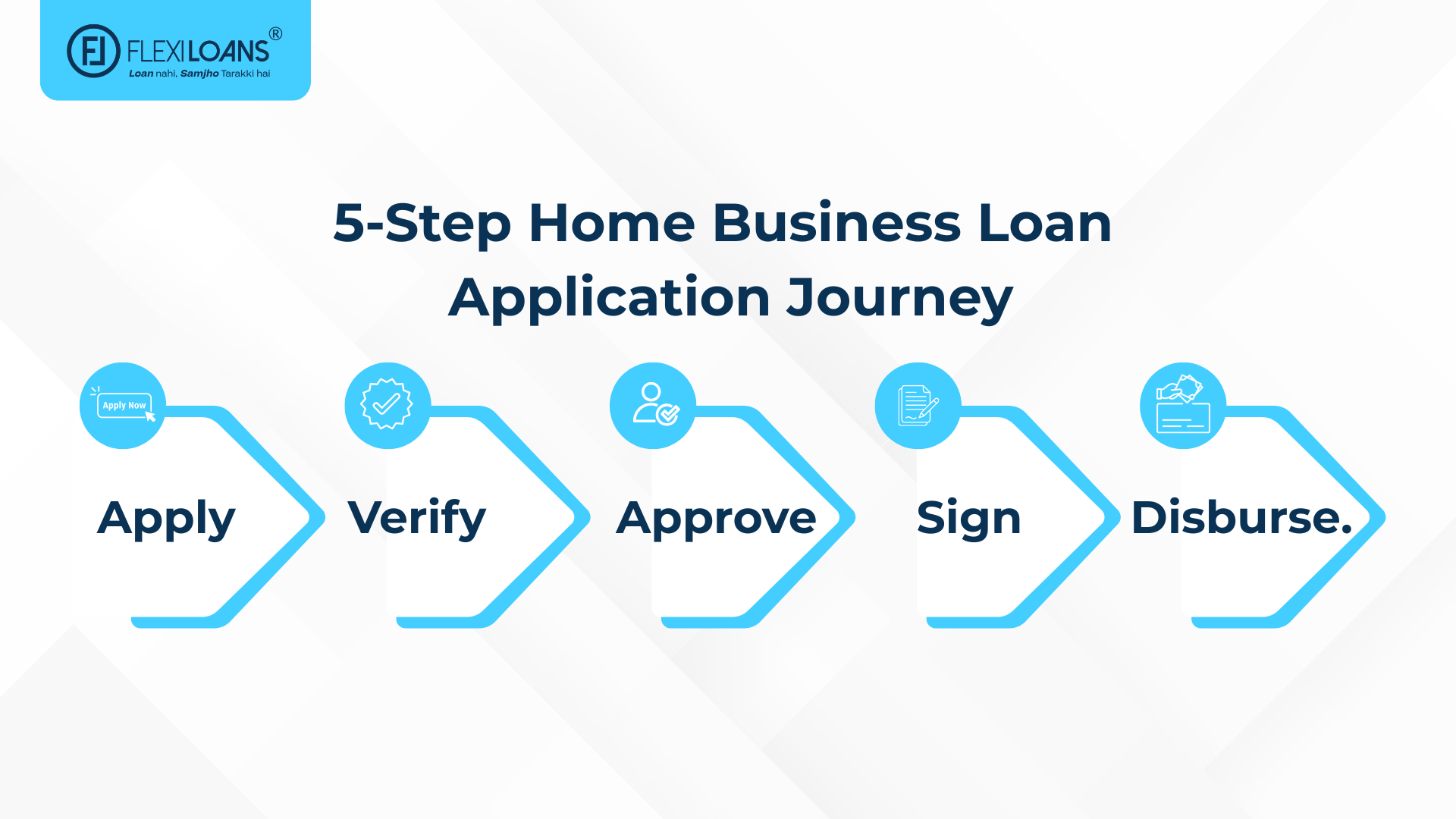
Applying for a business loan as a home entrepreneur is simple and fully digital:
- Complete the online application on the FlexiLoans website.
- Submit KYC details and recent bank statements.
- Undergo an eligibility assessment based on income and cash flow.
- Receive loan approval and offer details.
- Get funds disbursed directly to your bank account.
Why Choose FlexiLoans for Your Home Business Loan?
FlexiLoans understands modern, location-independent businesses. Our lending approach is designed to support entrepreneurs who operate outside traditional frameworks.
With FlexiLoans, you benefit from:
- Loans designed specifically for MSMEs and self-employed professionals.
- Fast approvals using data-driven credit assessment.
- Transparent pricing with no hidden charges.
- Loan amounts ranging from ₹50,000 to ₹50 lakh.
- Support for diverse home-based business models.
Smart Tips to Improve Home Business Loan Approval
To strengthen your application:
- Maintain regular bank account inflows.
- Separate personal and business transactions where possible.
- Avoid cheque bounces or overdrafts.
- Borrow only what your cash flow can comfortably support.
- Keep digital records and invoices ready for verification.
Conclusion
A home-based business loan enables entrepreneurs to unlock growth opportunities without stepping outside their homes. Whether you are investing in technology, expanding operations, or managing working capital, the right funding can accelerate your business journey.
With FlexiLoans, home-based entrepreneurs gain access to fast, collateral-free financing backed by transparent terms and flexible repayment options—allowing you to focus on building a sustainable and scalable business.
FAQs: Business Loan for Home-Based Business
Ans: Yes, operating from home does not restrict your ability to get a business loan. Lenders like FlexiLoans focus on your income consistency, cash flow, and repayment capacity, rather than whether you have a commercial office. As long as your bank statements reflect stable business activity, home-based entrepreneurs are eligible for funding.
Ans: No, home business loans offered by FlexiLoans are typically collateral-free. This means you do not need to pledge property, fixed deposits, or other assets. Approval is based on financial performance, business stability, and credit behaviour.
Ans: A wide range of home-based businesses are eligible, including online sellers, freelancers, consultants, digital marketers, tutors, content creators, home-based manufacturers, and service providers. The key requirement is demonstrable income through bank transactions, regardless of business model.
Ans: With digital lenders such as FlexiLoans, loan approvals are processed quickly, and funds are usually disbursed within 48–72 hours after successful verification. This makes home business loans ideal for urgent working capital or growth needs.
Ans: Yes. GST registration is not mandatory for all home-based businesses. If your business does not fall under compulsory GST requirements, you can still apply using bank statements, invoices, and alternative business proof to establish income and operations.
Ans: The loan amount depends on factors such as monthly cash inflows, business vintage, and credit profile. Typically, home-based entrepreneurs can access funding ranging from ₹50,000 to ₹50 lakh, subject to an eligibility assessment.
Glossary: Key Terms Explained
| Term | Definition |
| Home Business Loan | A business loan designed for entrepreneurs who operate their business from a residential or non-commercial location. |
| Self-Employed | An individual who earns income independently through a business, trade, or professional activity rather than salaried employment. |
| Collateral-Free Loan | A loan that does not require the borrower to pledge any asset, such as property, machinery, or deposits, as security. |
| Cash Flow | The net amount of money moving into and out of a business, indicating its ability to manage expenses and repayments. |
| CIBIL Score | A numerical credit score ranging from 300 to 900 that reflects a borrower’s creditworthiness and repayment history. |
| Working Capital | Funds are required to manage day-to-day business operations, such as inventory purchases, salaries, rent, and utilities. |
| EMI (Equated Monthly Installment) | A fixed monthly payment that includes both principal and interest, used to repay a loan over its tenure. |
| Loan Tenure | The total duration over which a borrower agrees to repay the loan amount to the lender. |
| Disbursal | The process by which the lender transfers the approved loan amount to the borrower’s bank account. |
| Digital NBFC | A non-banking financial company that uses technology-driven platforms to offer online loan applications and approvals. |
| Bank Statement Analysis | Evaluation of a borrower’s bank transactions to assess income stability, cash flow, and repayment capacity. |
| Udyam Registration | A government-issued registration that officially recognises a business as a Micro, Small, or Medium Enterprise (MSME). |
| Turnover | The total revenue generated by a business over a specific period is often used to determine loan eligibility. |
| Unsecured Loan | A loan provided without collateral, approved primarily on the basis of income, credit profile, and business performance. |
| Business Vintage | The length of time a business has been operational, which helps lenders assess stability and continuity. |

Is this information helpful?
 Disclaimer

Nishit Bhandari
Nishit Bhandari is a finance professional and content strategist at FlexiLoans. He focuses on MSME, business, and term loan solutions. With over 5 years of expertise in digital lending and credit access, he creates content that helps entrepreneurs make informed financial decisions. His work is driven by a passion to simplify complex finance concepts and empower small businesses to grow with confidence. Nishit holds an MBA in Finance from NMIMS, Mumbai, and is a Certified Credit Professional from IIBF.
Recent Posts
-
Business Loan Refinancing: Lower Your EMI & Interest Rate in 2026
Mar 05, 2026 -
Business Loan Maximum Amount: How Much Can MSMEs Borrow in 2026?
Mar 04, 2026 -

7 Government Schemes to Empower Women in India
Mar 03, 2026 -

Success Stories: How FlexiLoans Helped MSMEs Unlock Their Growth Potential
Feb 24, 2026 -
10 Smart Ways to Use MSME/SME Loans to Expand Your Business
Feb 23, 2026