
Sep 08, 2025
Feb 17, 2026
Understand how the 4-tier GST tax structure impacts product pricing, business compliance, and customer decisions across sectors in India.
Authored By FlexiLoans | Date: 08/09/2025
- Quick Summary
- What: GST slabs are 0%, 5%, 12%, 18%, and 28% rates applied to different goods and services.
- Why: They affect product pricing, tax compliance, and business profitability.
- Who: Relevant for all registered businesses, manufacturers, traders, and consumers.
- How: Use HSN/SAC codes and CBIC rate lists to classify items correctly.
- Use Case: 5% GST on packaged food, 28% on luxury goods, slab accuracy ensures compliance.
Introduction
Understanding GST tax slabs is essential for every Indian, whether you’re a business owner or a consumer. From buying groceries to selling goods, GST directly impacts pricing, compliance, and financial planning.
The Indian government classifies goods and services under different GST slab rates: 0%, 5%, 12%, 18%, and 28%. For example, sugar is taxed at 5%, certain fruits at 12%, and ice cream at 18%. These rates may seem simple, but applying them correctly often confuses even seasoned professionals.
GST replaced a maze of indirect taxes like VAT and excise duty, streamlining compliance. Yet, multiple slab categories and regular updates make it important to stay informed. In this guide, we explain GST slabs in easy-to-understand terms, so your business can stay compliant and you can make more informed decisions.
What is GST and Why Does it Matter?
Basics first! GST’s full form is Goods and Services Tax. It is a single indirect tax regime in India that came into effect on 1 July 2017, replacing many central and state taxes, including VAT, service tax, and excise duties. It brought together all the state and central taxes into a single tax regime.
There is a clear distinction between the old tax vs new tax regime. Knowing the GST Tax system is important since it directly affects business and consumer finances. Companies need to comply with the rules of GST for proper invoicing, price determination, and staying compliant to prevent legal issues and penalties.
History of GST in India
The history of GST goes back to the year 2000, when PM Atal Bihari Vajpayee set up a committee to draft the GST law. The tax system at the time was extremely complex to understand and follow. However, the implementation of GST phased out over time. Finally, the Parliament enacted the Goods and Services Tax Act on March 29, 2017, which became operative on July 1st. This is a destination-based tax law in India that is levied at every point of sale.
Objective of GST Tax Regime
Let’s take an example of a biscuit you buy every day. Biscuits were subject to many levels of taxation prior to the GST, with both central and state charges overlapping. On a base and the making price of ₹100, the maker paid 12.5% excise tax, leading to ₹112.50.
A 12.5% VAT was once again imposed, this time to a price that already contained excise duty after a wholesaler added margin. Due to cascading taxes, the ultimate price of the biscuits skyrocketed to ₹168.75 by the time they reached the shop and, subsequently, the consumer.
This “tax on tax” scheme increased the cost of products and complicated compliance since it lacked seamless input credit. The primary objective of GST is to make taxation easy, enhance compliance and enhance economic integration.
Importance of GST for Businesses and Consumers
The implementation of GST also provides many benefits to consumers and companies as well. GST for businesses reduces compliance costs, which helps consumers with lower prices. It also allows consumers to make better purchase decisions with GST clarity since prices of products can differ substantially depending on the GST rate applied.
GST has an impact on almost all economic activities in India, with implications for overall product prices, market competitiveness, and ease of doing business. It benefits the economy by increasing tax revenues and curbing tax evasion due to its transparency and uniformity. It has a profound effect on the growth and financial health of India.
Overview of the 4 GST Tax Slabs
Goods and Services Tax (GST) is a multi-tier tax system that aims to make taxes transparent and equitable. Depending on their nature and need, various products and services are taxed at different rates and are divided into four primary types. The GST rates breakdown follows as 5%, 12%, 18%, and 28%.
To maintain systemic equality, luxury and sinful commodities are subject to higher taxes, while necessities are subject to lower rates. All the GST slabs explained apply differently based on the type of goods or services.
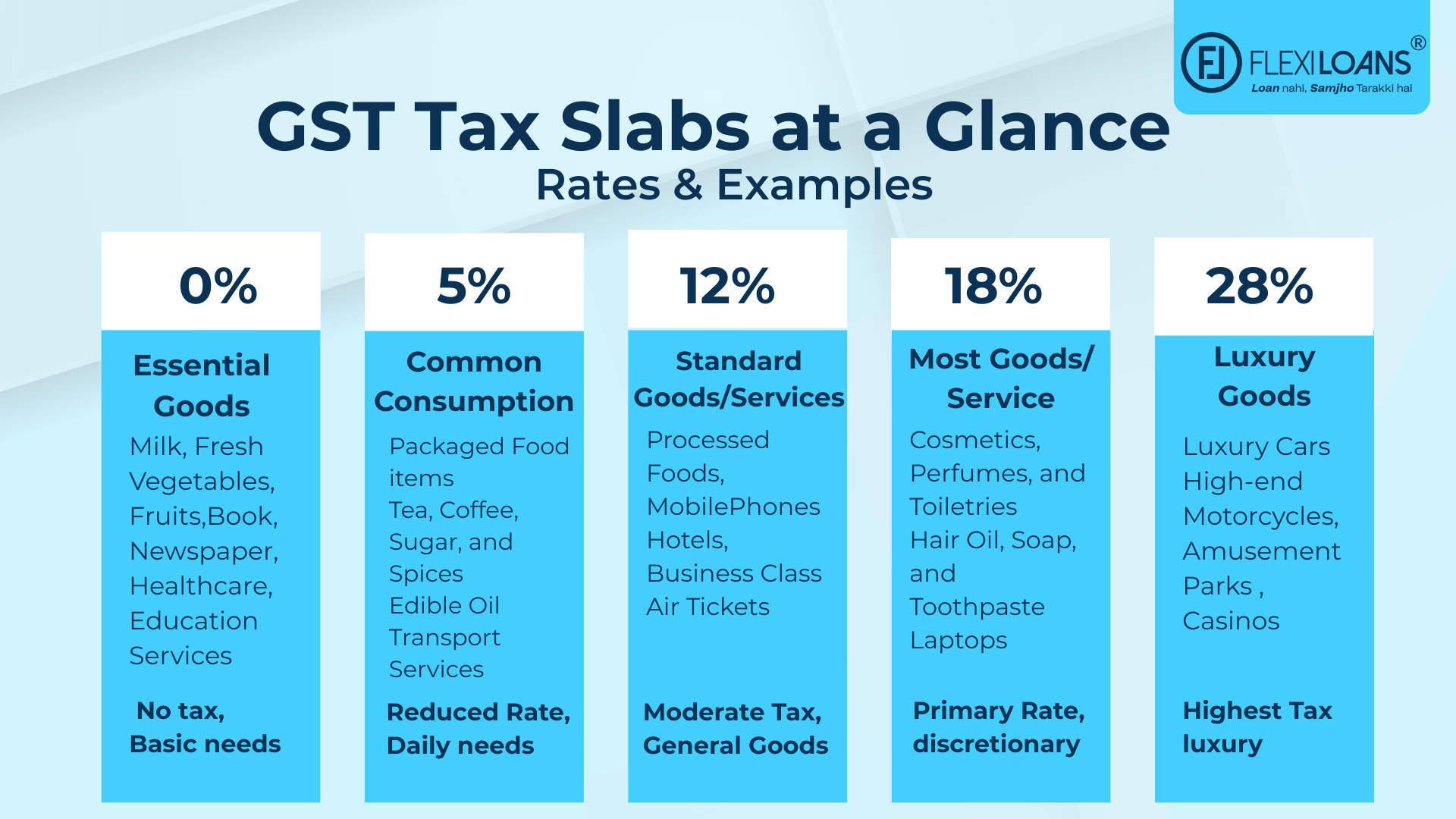
Detailed Explanation of Each GST Slab
Understanding this GST Tax Slabs overview can empower you to better assess the tax implications of purchases and sales, enhancing financial planning for individuals and businesses alike.
0% Slab
In order to maintain affordability and the general welfare, essential products and services are excluded from taxes under the 0% GST slab, commonly referred to as the zero-rated category. Fresh produce, milk, eggs, healthcare, and education services are all included in this slab.
| Products | Tax Rates |
| Fresh Vegetables | 0% |
| Milk | 0% |
| Eggs | 0% |
| Curd | 0% |
| Lassi | 0% |
| Salt | 0% |
| Atta (Unbranded) | 0% |
| Maida (Unbranded) | 0% |
| Gur | 0% |
| Besan | 0% |
| Prasad | 0% |
| Palmyra Jaggery | 0% |
| Phool Bhari Jhadoo | 0% |
| Educational Services | 0% |
| Health Services | 0% |
| Unbranded Natural Honey | 0% |
| Unpacked Paneer | 0% |
| Children’s Drawing & Coloring Books | 0% |
| Unpacked Foodgrains | 0% |
5% Slab
It is the lowest GST slab that covers essential items and services aimed at minimising financial burdens on everyday necessities. The 5% slab focuses on basic goods and services to maintain minimal prices for necessities. Some examples are:
- Restaurant services (non-luxury)
- Transportation services (economy class travel)
- Basic food items such as packaged paneer, edible oils, and spices
- Footwear priced under ₹1000
| Products | Tax Rates |
| All pre-packaged and labelled goods [other than fresh or chilled] | 5% |
| UHT milk | 5% |
| Skimmed milk powder | 5% |
| Paneer Branded | 5% |
| Eggs (not in shell) | 5% |
| Dried legumes (like dals) | 5% |
| Sweet potatoes | 5% |
| Cashew nuts | 5% |
| Dried mango slices | 5% |
| Frozen fruits and nuts | 5% |
| Coffee (roasted) | 5% |
| Cereals (e.g., rice, oats, etc.) – pre-packaged and labelled | 5% |
| Sugar | 5% |
| Tea | 5% |
| Coal | 5% |
| Edible Oils | 5% |
| Raisin | 5% |
| Domestic LPG | 5% |
| Footwear | 5% |
| Milk Food for Babies | 5% |
| Apparels | 5% |
| Fabric | 5% |
| Spices | 5% |
| Agarbatti | 5% |
| Mishti/Mithai (Indian Sweets) | 5% |
| Life-saving drugs | 5% |
12% GST Slab
This standard rate applies to moderately priced goods and services, balancing revenue generation and affordability. This slab consists of goods that are basic but slightly premium than necessities:
- Processed foods (butter, cheese)
- Mobile phones and specific electronics
- Construction materials (cement blocks, paints)
- Medicines and medical equipment
| Products | Tax Rates |
| Condensed milk | 12% |
| Butter | 12% |
| Ghee | 12% |
| Cheese | 12% |
| Almonds | 12% |
| Pistachios | 12% |
| Dates | 12% |
| Mangoes (dried) | 12% |
| Oranges | 12% |
| Lemons | 12% |
| Dried fruits | 12% |
| Refined sugar | 12% |
| Sugar cubes | 12% |
| Sugar boiled confectionery | 12% |
| Preserved meat | 12% |
| Roasted/salted nuts | 12% |
| Fruit juices | 12% |
| Mayonnaise | 12% |
| Batters | 12% |
| Namkeens | 12% |
| Bhujia | 12% |
| Mixture (snacks) | 12% |
| Computers | 12% |
| Mobiles | 12% |
| Packed Coconut Water | 12% |
| Umbrella | 12% |
18% GST Slab
Applicable to mid-range products and services, this slab targets non-essential items commonly consumed by middle-class populations. The 18% slab covers products considered standard but non-essential.
- Personal care products (soaps, shampoos)
- Air conditioners and refrigerators
- Auto parts and accessories
- Fashion clothing that has a higher price point
| Products | Tax Rates |
| Sugar confectionery | 18% |
| Malt, whether or not roasted | 18% |
| Glycerol, crude | 18% |
| Cocoa butter, fat and oil | 18% |
| Corn flakes, bulgar wheat, prepared foods obtained from cereal flakes | 18% |
| Pastry, cakes, biscuits and other bakers’ wares | 18% |
| Ice cream and other edible | 18% |
| Toothpaste | 18% |
| Industrial Intermediaries | 18% |
| Soap | 18% |
| Soups | 18% |
| Printers | 18% |
28% GST Slab
28% is the highest GST tax slab is reserved for luxury items and goods seen as harmful or non-essential, contributing substantially to revenue. It is reserved for harmful and luxury products that heavily influence prices:
- Luxury cars and SUVs
- Premium electronics (high-end televisions, cameras)
- Tobacco products and tobacco products
- Aerated drinks
| Products | Tax Rates |
| Small cars | 28% |
| High-end motorcycles | 28% |
| Consumer durables such as AC and fridge | 28% |
| Beedis are NOT included here | 28% |
| Luxury & sin items like BMWs, cigarettes | 28% |
| Aerated drinks | 28% |
| Goods Containing Added Sugar or Other Sweetening Matter or Flavoured | 28% |
| Caffeinated Beverages | 28% |
| Cement | 28% |
Knowledge of these GST slabs and their related products assists both businesses in precise pricing and customers in intelligent expenditure decisions.
Understanding GST slabs isn’t just about tax compliance; it’s about smarter pricing, better business planning, and building trust with your customers.
Effects of GST Tax Slabs on Consumers and Enterprises
There is a significant impact of GST slabs on consumers and businesses. Reduced GST slabs translate to affordability of basic commodities, whereas higher slabs make luxury and non-essential goods very expensive, influencing consumer spending habits.
Impact on Consumers
The implementation of GST is changing customers’ perceptions of price and decision-making processes. The GST streamlines the tax system and eliminates the “tax on tax” cascade effect by replacing many taxes, including VAT, excise, and service tax.
As a result, many everyday items and services now come at lower prices. Luxury products are taxed at a higher rate (28%), which again influences customer choices. Essential commodities, on the other hand, are taxed at lower rates (5% or excluded), making them more accessible.
With clearly stated tax splits on invoices, GST also guarantees pricing transparency. Since all states have the same tax rates, goods are priced equally throughout the country, which lessens regional pricing disparities. In general, GST impact on consumers encourages affordability, equity, and trust in consumer purchasing.
Impact on Businesses
For companies, GST slabs determine the way they charge for products, handle invoices, and file proper returns. Misclassifying or misinterpreting GST slabs can cause monetary losses or legal problems through improper tax payments.
- Simplified Tax Structure: GST eliminates confusion and boosts efficiency by replacing many indirect taxes (such as VAT, excise, and service tax) with a single, unified tax.
- Input Tax Credit (ITC): Companies can reduce their effective tax burden and increase profitability by claiming credit for the GST paid on purchases
- Standardised Invoicing: Invoicing that complies with GST improves record-keeping, decreases disputes, and promotes uniformity and transparency.
- Easier Compliance: Tax reporting is streamlined via an online GST return filing system, which saves time and lowers compliance expenses.
- Quicker Movement of Goods: Removing interstate entry tariffs and checkpoints expedites logistics and lowers expenses and delays associated with shipping.
- Transparent Taxation: Digital procedures and transparent tax rates discourage tax avoidance and encourage ethical company operations.
- Nationwide Market Access: Companies can grow and develop without facing state-specific tax issues thanks to uniform tax laws in every state.
- Better Business Image: Being GST compliant increases business credibility by fostering confidence with partners, investors, and consumers.
How to Determine the Correct GST Slab for Your Business
Determining the correct GST slab for your business is crucial to maintaining compliance, ensuring accurate pricing, and protecting your company from unnecessary penalties. GST on cakes, biscuits and bakers’ wares is 18% in India. If you are selling cakes and biscuits, you must select the correct GST slab of 18%. Here is how to determine GST slab with ease:
- Determine Your Good or Service: You must first be clear about your offering, whether it’s a product, a service, or a mixture of both (mixed or composite supply).
- Consult GST Rate List: To determine the appropriate slab (0%, 5%, 12%, 18%, and 28%), you must consult the most recent GST rate list released by the Central Board of Indirect Taxes and Customs (CBIC) or visit gst.gov.in.
- Make use of the SAC or HSN Code: HSN (Harmonised System of Nomenclature) codes are used to categorise products, whereas Service Accounting Code (SAC) governs services. Matching the proper code helps in determining the relevant GST rate.
- Recognise Special Categories: Certain products and services are subject to reversal charges, exemptions, or zero rates. For instance, expensive goods are subject to the 28% slab, while unbranded food grains can be excluded.
- Speak with a Tax Expert: To prevent misclassification and fines, seek advice from a GST practitioner or a certified public accountant for products with unclear classifications (such as cakes vs biscuits).
- Verify Updates and Notifications: Changes in GST rates are possible. Always keep up with the most recent rate alerts and government circulars. In addition to official updates, leverage user-friendly online GST slab calculators available on numerous trusted financial websites.
- Think About Composite vs. Mixed Materials: The main item determines the slab (composite) if you offer bundled goods or services. The highest slab (mixed) may be applicable if they are unrelated.
Ultimately, staying proactive and informed about GST slab classifications protects your business’s reputation and contributes positively to its overall operational health. For deeper insights and comprehensive guidance, businesses can also explore resources provided by the Central Board of Indirect Taxes & Customs (CBIC).
GST Tax Slabs Summary
Understanding GST tax slabs is essential for consumers and businesses alike. From pricing strategies to compliance and purchasing decisions, tax slab awareness influences day-to-day financial choices. Staying informed about the latest GST classifications can help prevent legal oversights and support more confident decision-making.
For businesses, especially MSMEs, managing GST compliance alongside financial planning is key. While GST streamlines taxation, ensuring liquidity and timely working capital access remains equally important. Platforms like FlexiLoans offer support in this area, helping businesses operate smoothly while staying compliant.
FAQs on GST Tax Slabs
5% is the lowest GST slab that the government levy on common-use items and services. It includes edible oil, sugar, tea, coffee, transport services, LPG (domestic), packaged food items, restaurant services (basic), and economy-class travel services.
The 28% slab targets non-essential and luxury items such as high-end vehicles, premium electronics, and tobacco. This discourages overconsumption and boosts revenue.
Exports are zero-rated under GST, meaning exported goods attract no GST, ensuring competitiveness in international markets.
Small businesses benefit from simplified GST slabs but must stay compliant to avoid penalties and manage costs effectively.
The current GST system in India has four main slabs: 5%, 12%, 18%, and 28%. These are structured based on the nature of goods and services, from essential items to luxury or demerit products.
GST uses a tiered rate structure to ensure the affordability of essential goods and higher taxation on luxury and harmful items. This prevents burdening low-income consumers while supporting government revenue from non-essentials.
Basic food items like milk, fresh vegetables, and cereals are either exempt or fall under the 5% slab. Processed and packaged foods, including snacks and butter, may attract 12% or 18% GST, depending on the product type.
Yes, GST rates are uniform across India. This consistency simplifies pricing, compliance, and interstate trade, ensuring products cost the same regardless of state.
You can use the HSN code (for goods) or the SAC code (for services) provided by CBIC to identify the correct GST slab. This ensures accurate invoicing and tax filing.
Incorrect GST application can result in penalties, interest liabilities, and issues in claiming Input Tax Credit. It also affects consumer trust and financial reporting accuracy.
Most goods and services fall under GST. However, essential services like education and healthcare are exempt, and items like petrol and alcohol are outside its scope for now.
Yes. The GST Council regularly revises slab rates based on inflation, industry input, and policy goals. Businesses must stay updated through gst.gov.in or official notifications to avoid misclassification.
Lower slabs make everyday goods affordable, encouraging consumption, while higher rates on luxury items may reduce demand. Overall, slabs guide consumer behavior and product affordability.
Glossary: Key Terms Explained
| Term | Definition |
| GST | Goods and Services Tax – India’s unified indirect tax system since 1 July 2017. |
| GST Slab | A predefined tax rate (0%, 5%, 12%, 18%, or 28%) applied to goods/services. |
| Input Tax Credit (ITC) | Credit that businesses can claim for GST paid on purchases. |
| HSN Code | Harmonised System of Nomenclature used to classify goods for GST purposes. |
| SAC Code | Service Accounting Code used to classify services under GST. |
| Zero-Rated | Goods/services taxed at 0% GST, mostly for exports and essential items. |
| Composite Supply | A bundled supply of goods/services treated as a single supply under GST. |
| Mixed Supply | Combination of two or more goods/services sold together but taxed individually. |
| Tax Compliance | Adhering to laws, filing returns, and paying applicable GST correctly. |
| Indirect Tax | A tax levied on goods/services rather than directly on income or profit. |

Is this information helpful?
 Disclaimer
Recent Posts
-

Business Loan Refinancing: Lower Your EMI & Interest Rate in 2026
Mar 05, 2026 -

Business Loan Maximum Amount: How Much Can MSMEs Borrow in 2026?
Mar 04, 2026 -

7 Government Schemes to Empower Women in India
Mar 03, 2026 -

Success Stories: How FlexiLoans Helped MSMEs Unlock Their Growth Potential
Feb 24, 2026 -

10 Smart Ways to Use MSME/SME Loans to Expand Your Business
Feb 23, 2026