

Understanding the right financing option for MSMEs and self-employed businesses after the Union Budget 2026.
Authored by FlexiLoans | Date: 02/02/2026
- Quick Summary
- What: The Union Budget 2026 introduced a dedicated MSME Growth Fund alongside ongoing credit support mechanisms, creating a choice between equity-like growth funding and traditional business loans.
- Why: MSMEs and self-employed businesses must now evaluate whether long-term growth capital or immediate debt financing better suits their operational and expansion needs.
- Who: MSMEs, self-employed professionals, small enterprises, and growing businesses seeking capital after Budget 2026.
- How: Compare eligibility, purpose, timelines, repayment expectations, and control implications between the MSME Growth Fund and business loans.
- Use Case: A growing services firm evaluates whether to seek patient capital under the MSME Growth Fund or opt for a fast business loan to manage cash flow and expansion costs.
The Union Budget 2026 placed renewed focus on strengthening India’s MSME ecosystem. Alongside continued credit reforms and ease-of-lending initiatives, the announcement of an MSME Growth Fund has introduced a new layer of financing choice for small businesses.
For MSMEs and self-employed professionals, this raises an important question. Should you opt for growth-oriented funding under government-backed initiatives, or should you rely on traditional business loans that provide immediate, structured capital?
This article helps business owners make that decision clearly. It explains what the MSME Growth Fund is, how it differs from business loans, and when each option makes financial sense, especially for businesses aligned with digital lenders such as FlexiLoans.
What is the MSME Growth Fund Announced in Budget 2026?
The MSME Growth Fund announced in the Union Budget 2026 is designed to provide long-term growth capital to small and medium enterprises with scalable business models. Unlike traditional credit, this fund focuses on strengthening balance sheets and supporting expansion rather than meeting short-term liquidity needs.
The Growth Fund is intended to:
- Support MSMEs with growth potential.
- Encourage formalisation and scale.
- Reduce over-dependence on debt for expansion.
- Complement existing credit guarantee and lending frameworks.
This form of funding is generally aligned with businesses looking to grow operations, invest in capacity, or strengthen their capital base over the long term.
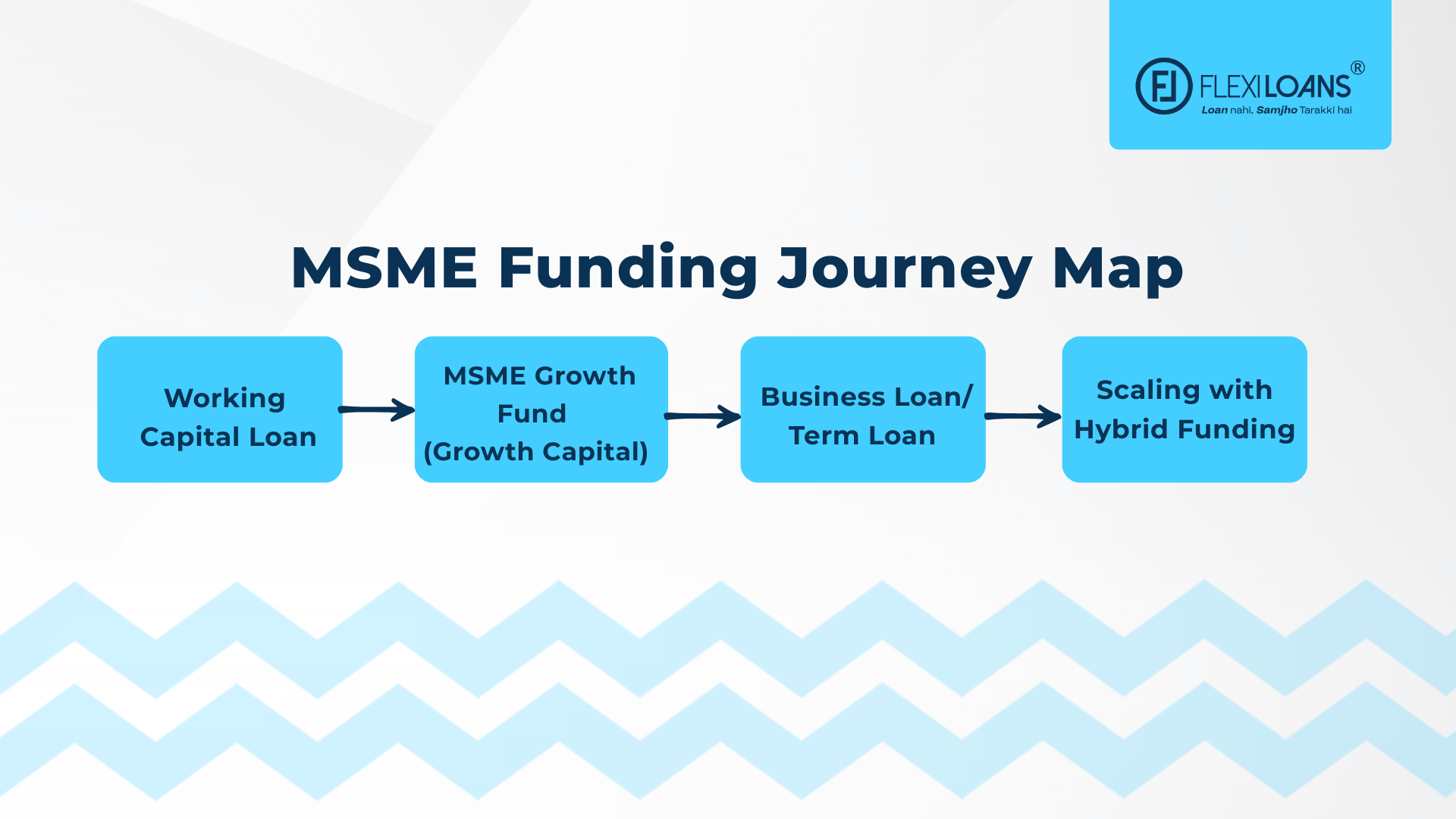
What are Business Loans for MSMEs?
Business loans are debt-based financing options provided by banks, NBFCs, and digital lenders. These loans are structured with fixed or flexible repayment schedules and are widely used by MSMEs to manage working capital, expansion, equipment purchases, and operational expenses.
Business loans typically offer:
- Faster access to funds.
- Clear repayment timelines.
- No ownership dilution.
- Flexibility in usage.
Digital NBFCs assess business performance, turnover, bank statements, and credit history to offer collateral-free business loans to eligible MSMEs.
Key Differences Between MSME Growth Fund and Business Loans
| Aspect | MSME Growth Fund | Business Loans |
| Nature of funding | Growth-oriented capital | Debt financing |
| Repayment | No regular EMIs | Monthly EMIs |
| Ownership impact | May involve structured participation | No ownership dilution |
| Time to access | Longer evaluation timelines | Faster approvals |
| Ideal for | Long-term expansion | Immediate business needs |
| Usage flexibility | Growth and scale-focused | Working capital, assets, operations |
Eligibility Criteria: Growth Fund vs Business Loans
MSME Growth Fund
Eligibility is generally aligned with:
- Registered MSMEs.
- Businesses with formal financial records.
- Scalable business models.
- Long-term growth plans.
- Compliance with regulatory and reporting norms.
Business Loans
Eligibility for business loans typically includes:
- Minimum business vintage.
- Stable monthly or annual turnover.
- Satisfactory credit profile.
- Valid business registration.
- Documented bank transaction history.
Business loans are often more accessible to small enterprises and professionals who may not yet qualify for growth-focused funding.
When Should You Choose the MSME Growth Fund?
The MSME Growth Fund may be suitable if:
- Your business is planning a large-scale expansion.
- You are not under immediate cash flow pressure.
- You are focused on long-term balance sheet strength.
- You can accommodate structured funding conditions.
- You do not require immediate liquidity.
This option is better viewed as strategic capital rather than operational finance.
When Is a Business Loan the Better Choice?
A business loan is often the right choice when:
- You need funds quickly.
- Cash flow gaps must be managed.
- Equipment, inventory, or staffing costs are immediate.
- You want predictable repayment schedules.
- You prefer retaining full ownership control.
For many MSMEs and self-employed professionals, business loans remain the most practical and time-efficient financing option.
How Budget 2026 Impacts MSME Credit Decisions?
Budget 2026 has reinforced the importance of formal credit access for MSMEs by:
- Encouraging diversified funding options.
- Strengthening institutional support mechanisms.
- Improving credit flow to smaller enterprises.
- Complementing digital lending ecosystems.
Rather than replacing business loans, these initiatives expand the financing landscape, allowing MSMEs to choose based on timing, purpose, and growth stage.
Why Business Loans Remain Relevant Post Budget 2026?
Despite new funding mechanisms, business loans continue to play a critical role because:
- Most MSMEs require short-term and recurring capital.
- Loan structures are simpler and more predictable.
- Digital lenders enable faster access and transparency.
- Loans support both growth and stability needs.
Lending Platforms such as FlexiLoans focus on enabling eligible MSMEs to access collateral-free business loans with minimal documentation and digital processing, aligning with the broader objective of improving MSME credit accessibility highlighted in Budget 2026.
Budget 2026 has expanded the financing landscape for MSMEs by introducing growth-focused capital alongside existing credit mechanisms. However, for businesses with immediate operational or expansion needs, structured business loans continue to play a critical role in ensuring liquidity, predictability, and continuity.
Conclusion
The choice between the MSME Growth Fund and business loans depends on your business stage, urgency, and financial objectives. Growth funds are designed for long-term expansion and capital strengthening, while business loans address immediate operational and growth requirements.
For MSMEs and self-employed businesses that need timely access to capital without ownership dilution, business loans remain a reliable and relevant financing option even after Budget 2026.
FAQs
Ans: The MSME Growth Fund is a government-backed initiative that provides growth-oriented capital to MSMEs with scalable business models. It is intended to support long-term expansion rather than short-term liquidity.
Ans: The Growth Fund focuses on long-term capital support and may not involve regular EMI repayments, while business loans are debt instruments with fixed repayment schedules and faster disbursal.
Ans: Eligibility and access depend on business profile, compliance, and funding needs. Some businesses may explore both options at different growth stages.
Ans: Yes. Business loans remain essential for working capital, operational expenses, and time-sensitive investments.
Ans: Self-employed professionals often find business loans more suitable because of faster approvals, flexible use, and predictable repayment structures.
Glossary: Key Terms Explained
| Term | Definition |
| MSME | Micro, Small, and Medium Enterprises are classified under Indian regulations based on turnover and investment thresholds. |
| MSME Growth Fund | A government-announced funding initiative in Budget 2026 aimed at supporting long-term growth and capital strengthening of eligible MSMEs. |
| Business Loan | A debt-based financing product provided by banks or NBFCs to fund business expenses, expansion, or working capital needs. |
| Working Capital | Funds are required to manage routine business expenses such as salaries, rent, inventory, and vendor payments. |
| Digital NBFC | A non-banking financial company that offers lending services through digital platforms with online processing and documentation. |
| Collateral-Free Loan | A loan that does not require the borrower to pledge physical assets, such as property or equipment, as collateral. |
| EMI | Equated Monthly Installment, a fixed payment made by a borrower at regular intervals to repay a loan. |
| Credit Profile | An assessment of a borrower’s financial credibility based on credit history, repayment behaviour, and outstanding obligations. |
| Business Turnover | The total revenue generated by a business over a defined accounting period. |
| Business Vintage | The length of time a business has been operational since registration or commencement. |
| Liquidity | The ability of a business to meet short-term financial obligations using available cash or cash equivalents. |
| Expansion Capital | Funds used to increase business capacity, enter new markets, or add services or infrastructure. |
| Balance Sheet | A financial statement that reflects a business’s assets, liabilities, and equity at a specific point in time. |
| Compliance | Adherence to applicable legal, regulatory, and statutory requirements for operating a business. |
| Loan Disbursal | The process by which approved loan funds are transferred to the borrower’s bank account. |