
Learn the MSME 45-day payment rule, its new tax implications under Section 43B(h), and how small businesses can stay compliant with practical steps.
- Quick Summary
- What: The MSME payment rule mandates that buyers must pay MSME-registered suppliers within 15 to 45 days
- Why: From FY 2024–25, delayed payments can lead to disallowed tax deductions under Section 43B(h)
- Who: Any business purchasing from MSME-registered vendors with valid Udyam registration
- How: Update contracts, ensure timely invoice clearance, and maintain payment documentation
- Use Case: A manufacturing firm lost tax deductions due to delayed payments to its MSME supplier post-April 2024
Late payments have long plagued India’s small businesses, prompting stricter government action. Under the MSMED Act 2006, buyers must clear invoices within 45 days (or 15 days if no written agreement exists) or pay compound interest at three times the RBI bank rate. Now, the Finance Act 2023 introduces a new tax rule: from 1 April 2024, expenses for payments delayed beyond 45 days to MSME‑registered suppliers will be disallowed under Section 43B(h), increasing your taxable income.
The government has also strengthened enforcement by enabling MSMEs to escalate disputes via the official MSME Samadhaan portal. If you deal with MSME vendors, ignoring this rule could affect both your cash flow and compliance credentials.
In this guide, we unpack the MSME 45‑day payment rule, explain who it applies to, detail legal and financial risks, and offer practical compliance steps, so you can stay tax-smart and supplier-trusted.
Who Does the MSME Payment Rule Apply To?
The MSME payment rule under the MSMED Act and Section 43B(h) of the Income Tax Act applies specifically when a transaction involves a buyer and a registered MSME supplier. Understanding who qualifies on both ends is critical for compliance.
The Supplier: Must Be a Registered MSME
- The rule is applicable only if the supplier is registered on the Udyam Registration Portal.
- Unregistered vendors, even if they meet MSME turnover or employee criteria, are not covered under this rule.
- The supplier must be classified as:
- Micro: Investment < ₹1 crore and turnover < ₹5 crore
- Small: Investment < ₹10 crore and turnover < ₹50 crore
- Medium: Investment < ₹50 crore and turnover < ₹250 crore
- Micro: Investment < ₹1 crore and turnover < ₹5 crore
To benefit from tax protection and payment timelines, the supplier must mention their Udyam Registration Number on invoices.
The Buyer: Any Business Entity
- The buyer could be:
- A private limited company
- A public sector unit
- A partnership, LLP, or even a proprietorship firm
- A private limited company
- There is no size threshold for buyers; any business entity delaying payment beyond 45 days is liable under this rule.
Key Point: The tax penalty applies only if the supplier is Udyam-registered. Buyers are advised to verify vendor registration before onboarding or contracting.
If a buyer misses the deadline, even by a day, the deduction is disallowed unless the payment is made before the end of the financial year.
Related Read How to Download Your MSME Certificate in 2025
What Are the Tax and Legal Implications of Missing the 45-Day Deadline?
Failing to comply with the MSME 45-day payment rule can have serious consequences, both in terms of tax disallowances and legal liabilities.
1. Tax Deduction Disallowed Under Section 43B(h)
With effect from 1 April 2024, the Finance Act 2023 introduced Section 43B(h) in the Income Tax Act. Under this provision:
Any payment to an MSME supplier made beyond the 45-day deadline will not be allowed as a business expense in that financial year.
This disallowance means:
- Your net taxable income increases
- You could pay more tax, even if the actual expense occurred
- The disallowed expense will only be claimed in the year the payment is made
For example, if a business pays a registered MSME after 60 days in May 2024, they can’t deduct that expense in FY 2024–25. Instead, they must wait until FY 2025–26, when the payment is made, to claim it.
2. Legal Interest Penalty Under MSMED Act
Under the MSMED Act, late payments attract compound interest at three times the RBI’s bank rate, automatically applicable once the due date lapses. This penalty is enforceable in court and is often awarded in favour of MSMEs that escalate the matter.
MSMEs can file delayed payment complaints via the official MSME Samadhaan portal, which forwards it to the appropriate Micro and Small Enterprise Facilitation Council (MSEFC) for resolution.
How to Stay Compliant With the MSME Payment Rule
To avoid tax disallowances and legal disputes, businesses must build a robust payment compliance process. Here’s a step-by-step guide to help you stay compliant with the 45-day MSME rule.
Identify and Verify MSME Suppliers
Before onboarding any vendor:
1. Ask for their Udyam Registration Certificate
2. Verify the Udyam number through the Udyam Verification Portal
3. Keep records updated for future audits
This ensures you know whether the 45-day rule applies before the first invoice is even raised.Include Payment Terms in Contracts
Clearly define:
1. Invoice date recognition (when does the 45-day countdown begin?)
2. Payment modes and timelines (e.g., NEFT by day 45)
3. Penalty clauses aligned with the MSMED Act (if applicable)
Avoid vague language like “within a reasonable time”; it won’t hold up legally.Automate Payment Tracking
Use accounting or ERP systems to:
1. Track due dates based on invoice receipt
2. Generate alerts for payments nearing the 45-day limit
3. Mark MSME vendors as high-priority to avoid manual error
This helps avoid missed payments, especially for high-volume transaction businesses.Maintain Documentation
In case of disputes or audits, ensure you have:
1. Timestamped proof of invoice receipt
2. Payment confirmation records
3. Signed agreements with clear timelines
This supports both your tax compliance and legal defence.Appoint a Compliance Owner
Assign someone from finance or legal to oversee:
1. MSME payment adherence
2. Tax disallowance risk assessments
3. Quarterly reporting of pending MSME dues
This creates accountability and ensures policy adherence across departments.
Real-World Examples and Industry Challenges
While the intent behind the MSME payment rule is to empower small businesses, its real-world implementation has raised concerns across industries, particularly those with long procurement cycles or complex payment structures.
Example 1: A Manufacturing Company and Its Supplier Delays
A mid-sized electronics manufacturer routinely sources components from 20+ small vendors. Although it has automated invoicing, approval delays across departments often push payments beyond 60 days.
Impact post-April 2024:
- ₹22 lakh in delayed MSME payments are now disallowed as expenses in FY 2024–25
- The company faces an additional tax burden of over ₹5 lakh
- Vendors have filed complaints via the MSME Samadhaan portal
Example 2: Apparel Exporter With Variable Cash Flows
A textile exporter purchases raw material from MSMEs but depends on overseas client payments to settle dues. Previously, delayed supplier payments were manageable. Now, they result in:
- Cash flow mismatches
- Inability to claim deductions, worsening quarterly tax estimates
- Growing mistrust among MSME partners
Example 3: Infrastructure Firm With 120-Day Cycles
Large EPC firms operating in government infrastructure face delayed fund releases from public bodies. Their typical payment cycle exceeds 90–120 days, clashing with the 45-day MSME rule.
Industry bodies like FICCI and experts from Deloitte have flagged this as impractical and are urging phased reliefs or industry-specific exemptions.
Sectoral Pain Points
- Construction & Infra: Long billing cycles
- Textiles: High MSME dependency + thin margins
- Retail: Volume-based invoicing with seasonal fluctuations
- Healthcare & Pharma: Multi-tier distributor invoicing adds delay
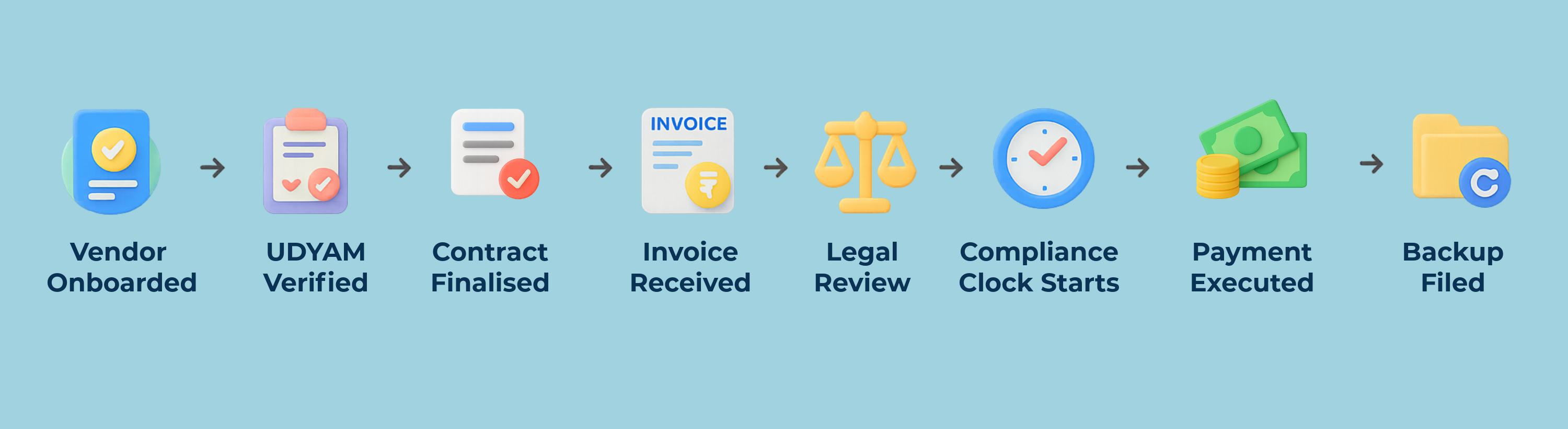
Formal Compliance Workflow: Legal Clauses, Documentation & MSME Samadhaan Handling
For businesses dealing with MSME-registered suppliers, compliance isn’t just about paying on time; it’s about ensuring that every agreement and action is legally sound and defensible. Here’s how to build a robust compliance workflow that meets both regulatory and tax standards.
Legal Clauses in Contracts
- Clearly state the invoice date as the trigger for the 45-day payment rule.
- Use definitive language like:
“Payment to be completed within 45 days from the date of invoice receipt, as per Section 15 of the MSMED Act.”
- Include a clause for Udyam Registration verification, requiring vendors to submit their certificate.
Contracts drafted with legal clarity help you defend against disputes and tax disallowance notices.
Documentation for Audit-Readiness
Maintain a digital folder per MSME vendor with:
- Signed agreements and updated Udyam certificate
- Invoice receipts and internal email confirmation
- Bank transaction proof with payment date reference
If faced with scrutiny by tax authorities or MSEFC, having this documentation is your strongest shield.
Handling MSME Samadhaan Complaints
When an MSME files a delay complaint at the MSME Samadhaan Portal:
- You’ll receive a formal notice from the Micro & Small Enterprises Facilitation Council (MSEFC)
- You must respond within the specified time, presenting your payment evidence or contractual reasoning
- If the Council finds the delay unjustified, it may:
- Order payment of dues
- Impose compound interest at 3× RBI’s bank rate
- Escalate to arbitration or legal forums if unresolved
- Order payment of dues
Steps to Protect Yourself as a Buyer
Whether you’re a small business or a large corporate buyer, protecting yourself under the new MSME rule involves proactive contract management, payment discipline, and internal accountability. Here’s how to stay on the safe side:
1. Classify All Vendors by MSME Status
Create two vendor lists:
- MSME-registered (Udyam verified)
- Non-MSME or unregistered
This helps your finance team clearly identify transactions that fall under Section 43B(h). You can link this with your vendor master in your accounting software.
2. Use “Compliant Contracts” Across the Board
Avoid verbal or ad hoc agreements. Each vendor contract should:
- Define the exact invoice acceptance date
- Specify 45-day payment commitment
- Mention interest penalties for non-compliance
You may also want to standardise clauses across departments to avoid internal conflicts.
3. Set Up Internal Payment SLAs (Service Level Agreements)
Your accounts payable team should have defined SLAs:
- Approve MSME invoices within 7 days of receipt
- Flag delays to legal/compliance teams if nearing the 30-day mark
- Set an escalation protocol for cross-department delays
4. Educate Your Teams, Cross-Functionally
Procurement, legal, and finance teams must understand the rule. Conduct internal workshops or circulate a compliance toolkit.
5. Keep an Eye on Evolving Tax Guidelines
The interpretation of Section 43B(h) could evolve with CBDT circulars or court rulings. Stay connected to tax advisory updates
Businesses often underestimate the ripple effect of delayed payments. What may seem like a minor cash flow management tactic for a buyer can jeopardize an entire supply chain. Timely settlement is not just tax-smart, it signals your business maturity.
Final Thoughts: Timely Payments Are Smart Business, Not Just Compliance
India’s regulatory shift with Section 43B(h) marks a turning point in how businesses engage with MSMEs. The 45-day payment rule is no longer just a legal formality—it’s directly tied to your tax planning, vendor relationships, and business integrity.
As a buyer, timely payments are a strategic move. They protect your tax deductions, strengthen your supplier ecosystem, and build operational trust. As an MSME, this regulation is a safeguard for your cash flow and growth.
Whether you’re structuring contracts, improving internal workflows, or educating your teams, every proactive step helps you stay ahead, not just compliant.
Partnering with lenders like FlexiLoans, who understand MSME dynamics, can further simplify your compliance journey and unlock smarter funding options based on business performance and transparency.
FAQs
Q1: What is the 45-day MSME payment rule?
It’s a regulation under the MSMED Act that requires buyers to pay MSME-registered suppliers within 15 days (if no written contract) or 45 days (if a written agreement exists). Delays beyond this can now lead to tax disallowances under Section 43B(h).
Q2: When did the tax implication of this rule take effect?
The tax provision under Section 43B(h) came into effect on 1 April 2024. It applies to payments made in FY 2024–25 and will impact tax filings for Assessment Year 2025–26 onward.
Q3: Does this rule apply to all vendors?
No. It applies only if the supplier is Udyam-registered as an MSME. If the vendor isn’t registered under the Udyam portal, Section 43B(h) does not apply.
Q4: Can payments be claimed as deductions in future years?
Yes. If a payment is delayed and not deductible in the current year, it can be claimed in the year when the actual payment is made, assuming it’s paid in full and accounted properly.
Q5: What are the consequences if the rule is violated?
Consequences include disallowed tax deductions, increased taxable income, and interest penalties under the MSMED Act (3× the RBI’s bank rate). The supplier may also file a complaint via the MSME Samadhaan portal.
Q6: Is there any exemption or grace period?
As of now, no exemptions or grace periods apply. Industry groups have requested relief for sectors with long payment cycles, but no official exemption has been announced by the government.
Q7: How can businesses prepare to stay compliant with the MSME payment rule?
Businesses should classify their vendors by MSME status, include clear payment timelines in contracts, automate invoice tracking, and assign internal accountability for MSME payments. Regular audits and Udyam verification are also key steps for smooth compliance.
Glossary: Key Terms Explained
| TERM | Definition |
| MSMED Act (2006) | Legislation that outlines the rights, classifications, and payment terms for Micro, Small, and Medium Enterprises in India. |
| Section 43B(h) | A provision under the Income Tax Act, introduced in the Finance Act 2023, disallowing tax deductions for payments made to MSMEs beyond 45 days. |
| Udyam Registration | Government portal-based registration required for MSMEs to be officially recognised and eligible for protection under MSME laws. |
| MSME Samadhaan Portal | An online grievance redressal system that allows MSMEs to file complaints about delayed payments. |
| MSEFC (Micro and Small Enterprises Facilitation Council) | State-level councils empowered to resolve payment disputes between MSMEs and buyers through legal or arbitration means. |
| Compound Interest (3× RBI Rate) | The interest penalty buyers must pay for delayed payments to MSMEs, calculated at three times the current RBI bank rate. |
| Assessment Year (AY) | The financial year in which income is assessed for tax purposes. For FY 2024–25, the corresponding AY is 2025–26. |